Can Towing Damage All-Wheel-Drive Vehicles?
A dead battery, flat tire, collision, or mechanical failure can leave an all-wheel-drive vehicle stranded without warning. At that point, one question matters before the truck arrives: can towing damage all-wheel-drive vehicles? Yes, it can - but damage is usually preventable when the vehicle is moved with the right equipment and procedure.
All-wheel-drive, often called AWD, sends power to all four wheels through a drivetrain that may include a transfer case, center differential, driveshafts, and electronically controlled clutches. Unlike many two-wheel-drive vehicles, an AWD vehicle cannot always be safely lifted by one end and towed with the other wheels rolling on the road. The towing method must match the vehicle.
Can Towing Damage All-Wheel-Drive Vehicles?
Improper towing can cause serious and expensive drivetrain damage. If two wheels are on the ground while the other two are lifted, the wheels may turn at different speeds. On many AWD systems, that difference can place stress on internal components designed to keep all four wheels working together.
Potential damage may involve the transfer case, transmission, center differential, driveshaft, or electronic AWD coupling. In some cases, damage happens quickly. In others, the vehicle may seem fine after the tow but develop noise, vibration, warning lights, leaking fluid, or poor handling later.
The risk depends on the make, model, model year, drivetrain design, transmission type, and whether the manufacturer provides a specific towing procedure. Some vehicles allow limited emergency towing under narrow conditions, such as a short distance at very low speed. Others must be carried with all four wheels off the ground. A trained tow operator should never assume that one AWD vehicle can be handled exactly like another.
The Safest Way to Tow an AWD Vehicle
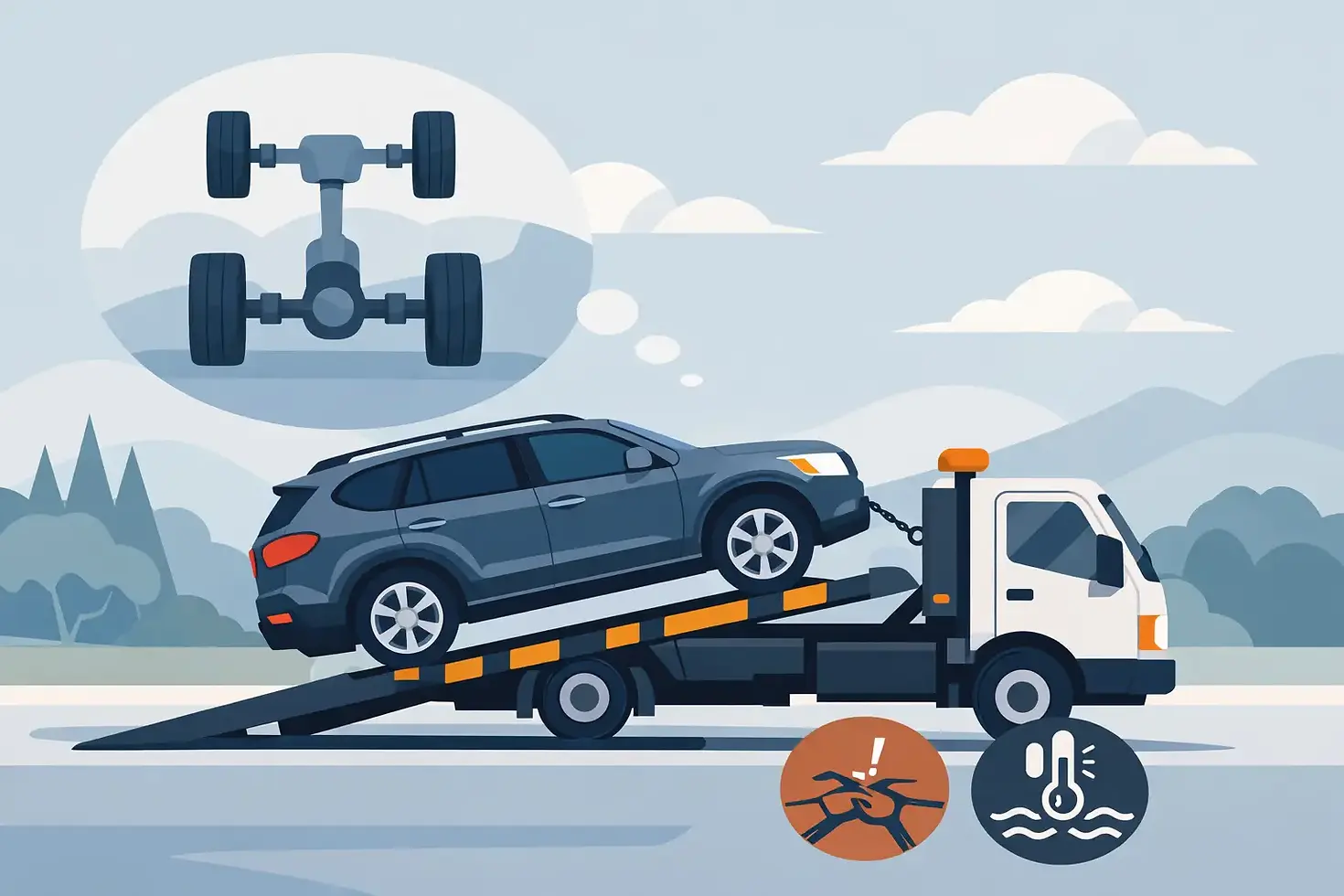
For most all-wheel-drive vehicles, a flatbed tow truck is the safest option. The vehicle is loaded onto the bed so all four wheels are off the pavement. Nothing in the drivetrain is forced to rotate while the vehicle is being transported.
This is particularly important when the vehicle will not start, has transmission trouble, has collision damage, or has a wheel, suspension, or axle issue. A flatbed also reduces the chance of additional damage from road debris, uneven pavement, or an improperly positioned tow connection.
A wheel-lift tow may be appropriate only when dollies are used to keep the remaining wheels off the road, or when the vehicle manufacturer specifically permits that method. Tow dollies support the wheels that would otherwise roll on the pavement, allowing the vehicle to move without turning components that should remain stationary.
The right approach is not always the fastest-looking approach. Taking a few extra minutes to load an AWD vehicle correctly can prevent a repair bill that costs far more than the tow itself.
Why Two Wheels on the Ground Can Be a Problem
When an AWD vehicle is pulled with only the front or rear wheels lifted, the wheels on the ground continue to spin. Depending on the drivetrain layout, that motion can back-drive parts of the transmission or transfer case without normal lubrication or engine operation.
Some systems tolerate this better than others. For example, a vehicle with a manual transmission and a manufacturer-approved neutral setting may have different rules than a modern crossover with an automatic transmission and active torque distribution. That is why a vehicle owner’s manual is the final authority for a specific vehicle.
Never rely on the idea that placing the transmission in neutral automatically makes an AWD vehicle safe to tow. Neutral does not always disconnect every driveline component.
What to Tell the Tow Operator Before Loading
Clear information helps the operator bring the right truck and plan the safest recovery. When requesting service, say that the vehicle is all-wheel drive and provide the year, make, and model if available. Mention whether it is running, whether it can be shifted into neutral, and whether there is visible wheel, suspension, or accident damage.
It also helps to explain the vehicle’s location. A vehicle in a driveway, underground garage, narrow shoulder, ditch, parking structure, or snow-covered area may require a different setup than a vehicle parked safely on a level road. If the vehicle has aftermarket modifications, unusually low ground clearance, oversized tires, or a locked steering wheel, mention those details as well.
If you have the owner’s manual in the vehicle, point out any towing instructions. Professional operators regularly work with manufacturer guidance, but the manual can confirm special procedures for that exact model.
Common Mistakes That Put AWD Drivetrains at Risk
The most common mistake is assuming that AWD is the same as front-wheel drive or rear-wheel drive. A tow that works safely for one drivetrain can be wrong for another.
Another problem is moving the vehicle before its condition is assessed. After a collision, a wheel may be bent, a tire may be flat, or a suspension component may be broken. Pulling a damaged vehicle onto a truck without proper equipment can create more harm. In recovery situations, careful winching, wheel skates, dollies, or specialized rigging may be needed.
Owners can also create risk by attempting an improvised tow with a rope, chain, or another vehicle. Apart from the potential drivetrain damage, this can be dangerous for everyone nearby. Modern AWD vehicles often have electronic parking brakes, steering locks, low ground clearance, and advanced safety systems that make an unplanned roadside tow a poor choice.
Finally, do not leave a vehicle in gear or with the parking brake applied while it is being loaded. Let the tow operator know if the vehicle cannot be shifted into neutral or if the brake is stuck. There are safe methods for loading immobilized vehicles, but forcing it to move is not one of them.
Does the Distance of the Tow Matter?
Distance matters, but it does not make an unsafe method safe. A short tow with two wheels on the ground can still damage an AWD system if the vehicle manufacturer does not allow it. The same is true of low speeds. A few blocks may feel harmless, yet drivetrain components can be under stress from the first rotation.
Long-distance towing raises the stakes because the vehicle is exposed to more time, more road vibration, and more opportunities for a small problem to become a costly one. For transport across the Niagara Region or beyond, flatbed service is generally the practical choice for AWD vehicles unless the manufacturer states otherwise.
What to Do After an Improper AWD Tow
If an AWD vehicle was towed with two wheels on the ground and you are concerned about damage, do not ignore new symptoms. Watch for grinding, whining, clunking, vibration, burning smells, fluid leaks, dashboard warnings, difficulty shifting, or changes in how the vehicle turns and accelerates.
Have the vehicle inspected by a qualified repair facility before returning it to regular use, especially if it was towed for more than a very short distance. Keep any towing paperwork and note how the vehicle was transported. That information can help a technician diagnose the issue.
If you are stranded, the immediate priority is getting the vehicle out of traffic and moved safely. Tell the dispatcher it is AWD, avoid improvised towing, and ask for a flatbed or the manufacturer-approved method. Regional Towing has provided professional, 24/7 roadside assistance and vehicle recovery in the Niagara Region since 1988, with trained operators equipped to assess how your vehicle should be moved.
Your AWD system is designed to give you better traction when conditions are difficult. It deserves the same care when the vehicle needs a tow: use the correct equipment, provide accurate information, and let a trained operator handle the transport.